Bruce Lehrmann sued Channel 10 for defamation in a civil court, not a criminal court. The burden of proof is lower than “beyond all reasonable doubt”, but a little known legal principle was applied correctly to weigh the facts of the matter based upon the balance of probabilities.
For high profile media personality and Roman Catholic priest Father John Fleming, the judge in his defamation trial wasn’t seen to be so compliant with objective justice.
Justice Michael Lee’s approach to the finding of fact in the recent civil defamation case of Lehrmann versus Channel 10, highlights the fundamental flaw in legal reasoning followed by the South Australian Supreme Court in the defamation case of Fleming v Advertiser-News Weekend Publishing Company in 2016.
Justice Lee, in company with all other judges involved in defamation cases in Australian Courts, stated that the Briginshaw principle must be applied in determining the truth of a matter based upon the balance of probabilities.
The seriousness of an allegation made, the inherent unlikelihood of an occurrence of a given description, or the gravity of the consequences flowing from a particular finding are considerations which must affect the answer to the question whether the issue has been proved to the reasonable satisfaction of the tribunal. In such matters “reasonable satisfaction” should not be produced by inexact proofs, indefinite testimony, or indirect inferences.
Dixon J, Briginshaw v Briginshaw, [1938] HCA 34, 60 CLR 336 at p 362
In his newly published book, Supreme Injustice (2024), Father John Fleming demonstrates that his was the only case in which the High Court judgement of Briginshaw was declared no longer to apply in establishing the proof on the balance of probabilities.
That Court was wrong. In law.
And the Australian High Court has refused to do anything about it.
Father Fleming, a Catholic priest and academic, sued for defamation over stories published in an Adelaide newspaper alleging, as a matter of truth, sexual involvement with an underage female. The Court of Appeal in SA stated unequivocally that:
We would add that, although in Briginshaw Dixon J referred to a person against whom are alleged serious matters enjoying the “presumption of innocence” and the consequent requirement of “exactness of proof”, the later High Court judgments do not import that presumption into the civil arena. Furthermore, from the above it would appear that any references to Briginshaw as establishing an “onus” or a “standard” are incorrect. Additionally, in the several High Court cases referred to, there is no reference to Briginshaw establishing a “principle”.

Father Fleming was denied the presumption of innocence so that the onus of proof was instead placed on him to disprove an allegation, rather than the newspaper having to prove what it said was true.
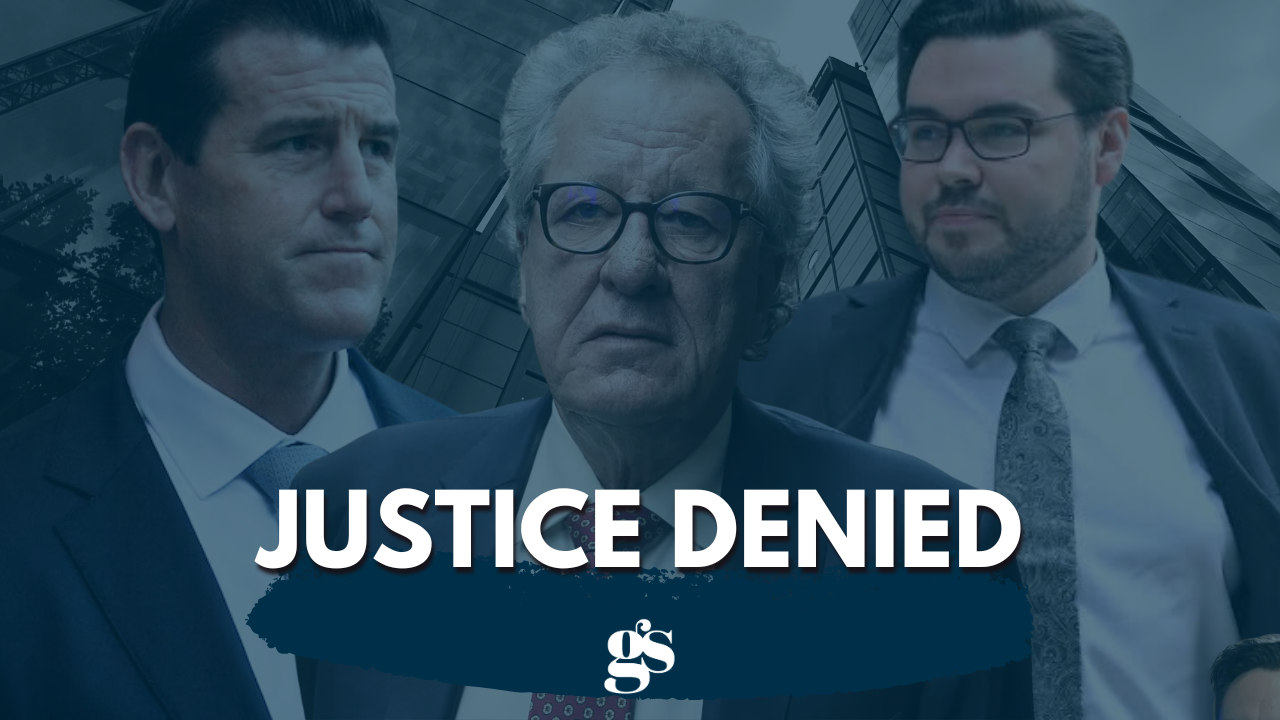
Since then, other Australian Courts have explicitly applied Briginshaw when actor Geoffrey Rush (2019), Australian war hero Ben Roberts-Smith (2023) and now Bruce Lehrmann sued for defamation. Where Rush was concerned Justice Wigney drew particular attention to the necessity for corroboration.
Even worse, the same SA Supreme Court of Appeal itself did apply Briginshaw in Poniatowska v Channel Seven Sydney in 2019, just three years later.
Was Father Fleming denied justice because of anti-Catholic prejudice, and because of the prejudicial culture that female accusers of Catholic priests are always to be believed?
Accusations against Father Fleming were not corroborated, but each one of his witnesses, including an eyewitness, corroborated Father Fleming’s evidence.
Errors in logic, judges misrepresenting evidence, and an arbitrary preference for the witnesses for the defence over and against those of Father Fleming indicated bias against him.
Father Fleming’s self-published book is titled, Supreme Injustice: Guilty until proven Not Catholic?
WHAT DO YOU THINK? Add your comments below...
This free service - independent, right thinking media - exists because people like you donate a small amount every month.
No government is going to fix the Lying Harlot Media - they're never going to subsidise the news & views people need to hear. And nor should they, because if your media source depends on government subsidies, how could you trust its independence?
The Good Sauce is bringing the best of thinking about important issues, arguments rarely seen elsewhere, into one convenient website with weekly email updates direct to your inbox. But our existence and growth really depends on generous monthly supporters - people like you. Become a Good Sauce supporter today and help us grow to better serve you for the long term.