
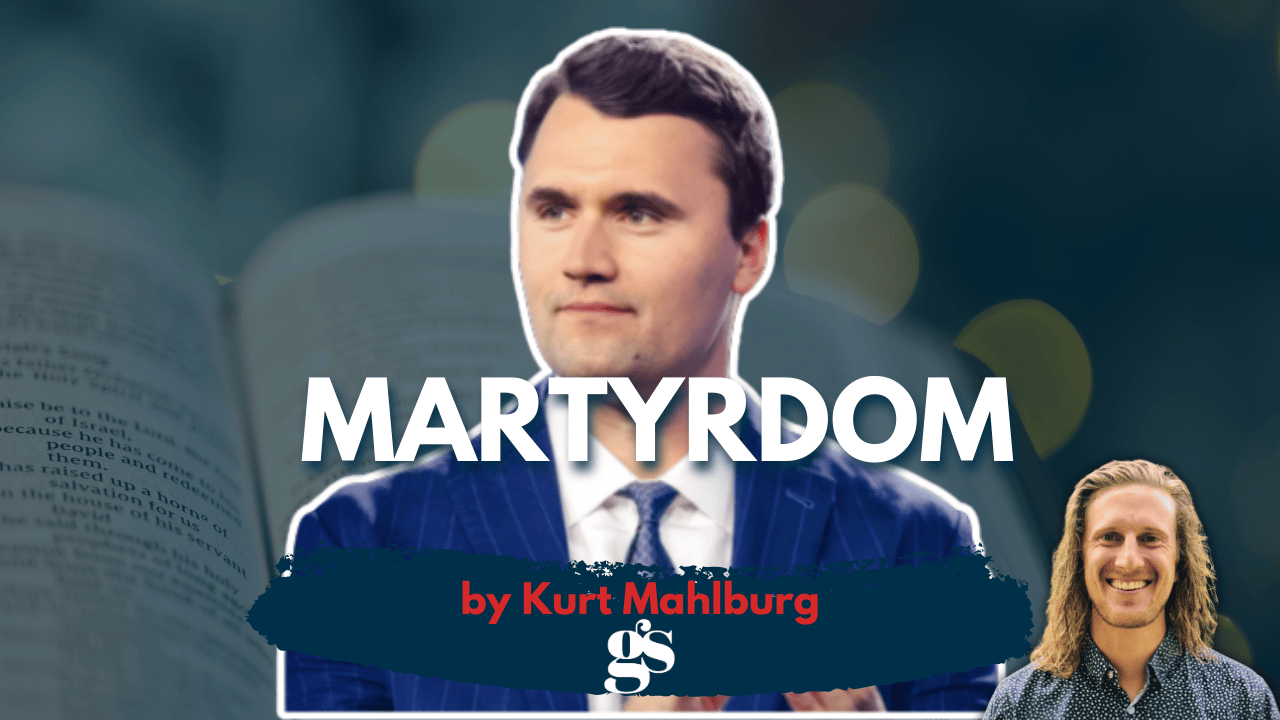
It wasn’t long after Charlie Kirk’s assassination that sympathetic voices had dubbed him a martyr.
In particular, he was widely lauded as a martyr for free speech, even by those who didn’t share all his convictions.
Perhaps in a bid to downplay the plaudit, many critics dismissed Kirk as little more than a MAGA martyr — a label that, ironically, likely pleases the average Trump supporter all the same.
While libertarians, progressives and rusted-on Trump types are welcome to make their various assessments, the question that interests me is if Charlie Kirk is a martyr for his Christian faith — which is the classic meaning of that word.
Legacy media outlets and social media pundits were quick to answer this question with an emphatic no.
The claim that Charlie Kirk doesn’t meet the definition of a martyr appears to rest on three underlying assumptions, which I will address below.
Spoiler alert: Viewed in light of centuries of Christian martyrdom, Charlie Kirk does indeed fit squarely within this tradition.
1. Charlie Kirk was a political figure, not a religious one
The first point to address is the one you’ve probably heard most often — that Charlie Kirk was a political figure, not a religious one, and martyrdom requires a purely (or at least predominantly) religious motive.
According to this line of reasoning, Charlie can’t be counted as a martyr because he was engaged in political activism and sought to advance political causes.
But if we apply the same standard to martyrs throughout church history, many of them don’t count as martyrs either.
Christian martyrs of the medieval period who were killed by pagans in Northern Europe — men like Saint Boniface (754), Saint Adalbert of Prague (997), and Saint Bruno of Querfurt (1009) — were not bringing the gospel message in isolation. They also sought to introduce literacy, law, church authority and civic order to the pagan world. In a word, they were emissaries of Christian civilisation. Yet they are also canonised martyrs.
The same might be said of Protestant missionary martyrs like:
- John Williams (1796–1839), killed in Vanuatu, who worked to promote literacy, education, and crafts among the Polynesians
- James Chalmers (1841–1901), martyred by islanders in Papua New Guinea, who sought to broker peace among warring tribes
- Jim Elliot (1927–1956), speared in Ecuador, who advocated for education and community development among the Huaorani
Each of these men preached the gospel, but they didn’t limit their ministry to words alone — they also laboured to see Christianity shape the social and political life of the places God sent them. Yet their political engagement did not strip them of their martyr’s crown.
Charlie Kirk was no different. He was taking the values of Christian civilisation — ideas like the right to life, freedom of speech, traditional marriage, and sexual ethics — into the most hostile mission field you’ll find in the post-Christian West: the university campus. And he did so while unashamedly preaching the gospel.
Martyn Iles agrees that Charlie Kirk deserves the title martyr. He wrote:
“Yes, [Charlie Kirk] was political, but any honest observer must note that he preached the gospel over and over and over, using his advocacy work as a platform for it. It was his first love and he didn’t hide it. And, he overtly anchored many of his main points in the Bible and in the work of Christ.”
You might disagree with Charlie Kirk’s arguments or his politics, but that doesn’t change his underlying motivation, nor the way Christians have recognised martyrs for millennia.
2. Charlie Kirk’s mission was not explicitly evangelistic
A related objection is that Charlie Kirk’s goal in debating students at universities was not explicitly evangelistic.
But this fails for a similar reason to the argument above. Christians regularly engage in non-“gospel” work that creates a context to share their faith — whether soup kitchens, food pantries, surf schools or missionary “tent-making” overseas.
If a Christian is engaged in such activity, and uses it as a platform to share the gospel, we wouldn’t deny them the title martyr if they were murdered by someone who hated what they stood for. So why the double standards for Charlie Kirk?
As theologian Joe Rigney has explained:
“Like the apostles, Charlie was known for his boldness… courage and clarity about Jesus and sin. Charlie’s primary mission in life was to take the truth to America’s university campuses… With humour and kindness, he patiently exposed such lies and sought to point his audience back to truth, to reality, to Christ…
“In other words, Charlie Kirk was a martyr. The original meaning of that term was “witness,” someone who testified to some great truth. It came to bear its modern meaning because such testimony to the truth frequently met with hostility, violence, and death. Charlie Kirk is now a martyr in both senses.”

Moreover, while Charlie regularly fielded questions about social or political issues, he very often pointed questioners back to Christianity, arguing that the Bible provides the answers our world needs.
It’s for this reason that Charlie Kirk may in fact have been one of the most prolific evangelists of the last few decades.
What’s more, as an outcome of his death, it’s not a political renaissance that has set tongues wagging, but a spiritual revival, with hundreds of thousands — possibly millions — of people attending church for the first time or inquiring about the Christian faith.
3. The assassin didn’t explicitly target Charlie for his Christianity
The third objection is that Charlie Kirk doesn’t count as a martyr because his killer didn’t clearly articulate that Kirk’s Christian faith is the reason he carried out the murder.
However, by this logic:
- John the Baptist wasn’t martyred for his faith — he was just beheaded for criticising King Herod’s incestuous marriage
- Polycarp of Smyrna wasn’t a Christian martyr — he was simply burned and stabbed for refusing to show full loyalty to Rome
- Dietrich Bonhoeffer wasn’t martyred for his Christian witness — he was merely hanged by the Nazis for plotting to assassinate Adolf Hitler
- The Apostle Peter wasn’t martyred for Christ — he was just crucified because Nero saw Christians as a threat to his power and a convenient scapegoat for the Great Fire of Rome
- The Apostle Paul and other early believers weren’t martyred as Christians — they were simply killed for threatening civic stability
- Jesus Christ himself, the prototype martyr, didn’t die for claiming to be the Messiah and God incarnate — he was merely executed by Roman authorities to forestall Jewish unrest in Judea.
Notice what happens when we take these semantic games to their logical conclusion: the concept of martyr disappears entirely.
Why? Because a martyr isn’t defined by how his or executioner justifies their bloodlust. He is a martyr because his Christian faith caused his enemies to hate what he represented, oppose the truth he embodied, and finally commit murder to silence his witness.
Looking more closely at Charlie Kirk’s death, we know that his assassin viewed Charlie as a “fascist”, disagreed with his views on transgenderism, and had “had enough of his hatred”.
Thus, some have argued, Charlie Kirk was assassinated merely for his political viewpoints. But this makes the same mistake as the absurd examples listed above. Charlie Kirk believed what he did about conservatism in general and transgenderism in particular because of his Christian faith.
A Final Word
Each of the arguments that have been used to challenge Charlie Kirk’s standing as a martyr stumble upon the same error — namely, they create a false separation between our spiritual lives and the rest of our lives.
The modern world inherited this artificial division from Greek thinking, but it is foreign to Jewish culture and, more importantly, foreign to the Scriptures. The New Testament emphatically teaches that Jesus Christ is Lord of all (Colossians 1:16–18) and that we are to present all that we are as a living sacrifice to God (Mark 12:30, Romans 12:1–2, Colossians 3:17), not just the parts we find convenient.
In the words of Dutch theologian and politician Abraham Kuyper (1837–1920),
“In the total expanse of human life there is not a single square inch of which Christ, Who alone is sovereign, does not declare, ‘That is Mine!’”
Put simply, Christianity cannot be bifurcated into word or deed, theory or practice, confession or obedience. Either it’s true and applies to all of life or it’s false and does not.
Charlie Kirk believed this and lived this out. His political convictions and activities were an undeniable outgrowth of his Christian faith.
Instead of seeking to deny Charlie his martyr’s crown, perhaps we’d do better by imitating the example of his life.
WHAT DO YOU THINK? Add your comments below...
Kurt Mahlburg has studied architecture and theology among other interests of philosophy, history, surf, the outdoors and travel. He spent several years in Indonesia and has worked as a young adults pastor. He is now a teacher, a freelance writer, the Features Editor of the Canberra Declaration and contributes regularly at Caldron Pool & other online publications. He hosts his own blog 'Cross + Culture' at KurtMahlburg.blog. Follow Kurt on 𝕏.
Check out Kurt Mahlburg’s new book Cross and Culture: Can Jesus Save the West?


