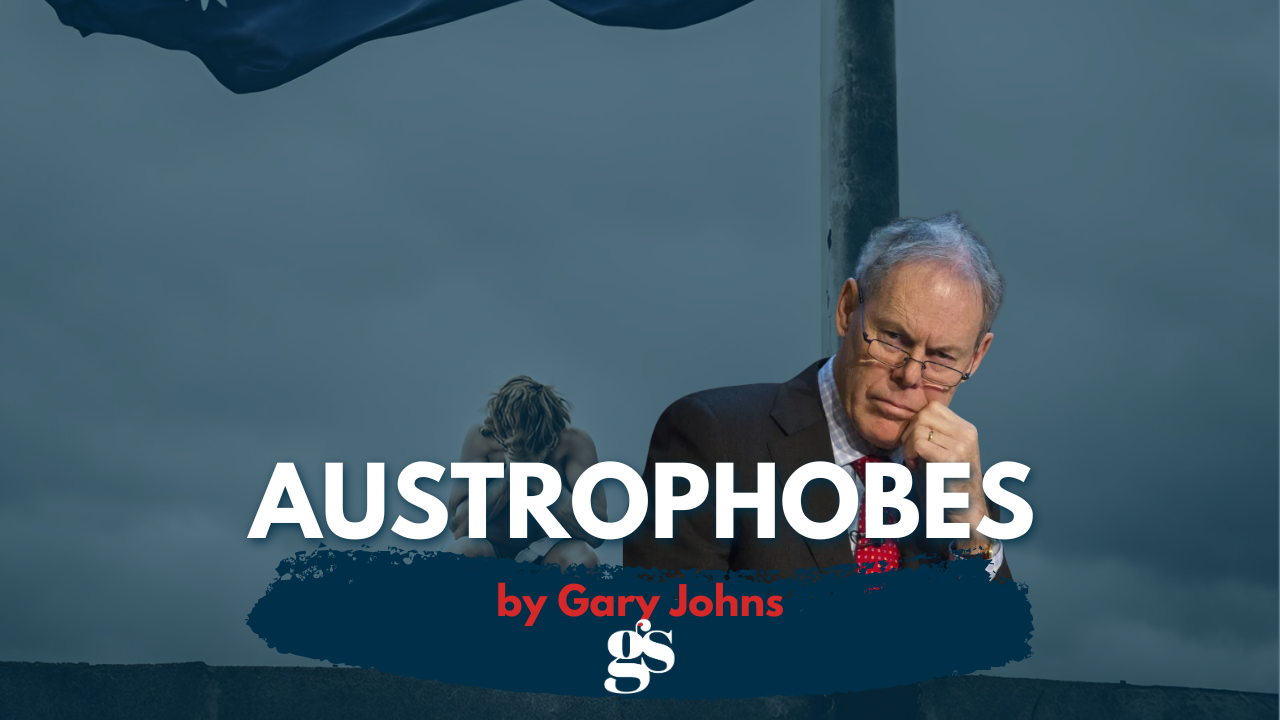
Much has been written of Australian soccer captain Sam Kerr’s big night out in the back of a London cab. A recent piece by Luke Pearson of ‘indigenousX’, ‘Is it possible to be racist to white people?’, was his attempt to explain the controversy over the alleged remarks by Kerr, whose father is part Indian and mother white, against a white policeman in England.
Sam Kerr’s genealogy should not matter. But, in the minds of many, like Luke Pearson, it is crucial to her guilt or innocence. Luke runs courses in anti-racism. Luke has a father of Aboriginal descent, but his mother does not, meaning that he is both oppressed and oppressor. To squeeze every advantage from his love of critical race theory and race-based ideology, he believes that all ills can be laid at the feet of racism, even when he, as a graduate, is privileged. He seems to be an angry man who possibly learned his radicalism from his alma mater, the University of Newcastle, which specialises in identity recovery.
One of his courses explores ‘the 500-year story of race and racism’. Five hundred years is about the time that Europeans started their discovery of the new world, that is, the comAmencement of so-called ‘colonialism’. Except, it wasn’t. Luke had better hide from his students the four volumes of the Cambridge World His tory of Slavery. Slavery was the most common form of subjugation in all societies capable of keeping slaves. Asians and Arabs, when they were more powerful, took whites into slavery. Hunter-gatherers did not. Not because they were not racist, but because they could not keep slaves. They could barely keep themselves. The irony is that it takes a certain amount of civilisation to keep slaves. It takes a heck of a lot more to prevent it; only the Europeans, the white man, in the first instance, have done so.
As an exercise, Luke asks people in his workshops how indigenous people can use racism to ‘reduce the average life expectancy of white people’, ‘increase their likelihood of incarceration’, ‘increase their chances of having their children removed from their care’, and so on. He rails, that is what racism does to ‘us’, ‘so if we can be racist to them, why doesn’t it have the same impact on them? Why doesn’t racism benefit us in the way it benefits white supremacy?’ The exercise leads students to lay all the blame on one cause – the white man’s racism, just like the white policeman.
Luke has swallowed the whole race theory thing. How sad. Here he is, privileged, educated, and apparently bitter. He fails to realise that he will have the same life expectancy as other Australians consistent with his genetic makeup because he completed school, is a teacher, and has his own business. If he looks after himself, for which he alone is responsible, he will have a good life, a loving family, and free of incarceration.
Luke wrongly suggests that racism arose ‘around the Enlightenment when white people were positioning themselves as the superior race, with not just superior cultures, superior intellects and superior institutions but also superior morals and ethics’. They do ‘terrible things for power and profit while still believing themselves to be good people’. ‘Alas, dear Luke, you suffer from what Nigel Biggar (Colonialism: a Moral Reckoning) labels an ‘unscrupulous indifference to historical truth.’ The Enlightenment did not invent empire; tell that to the Assyrians. It did invent the equal value of each person.
Luke’s anger extends to good people of Aboriginal descent. ‘Imagine an indigenous person who builds a political career… from denying the existence of racism or the ongoing impacts of colonisation on other indigenous people. They can directly benefit from racism for personal and political gain’. A shot at Senator Jacinta Price and Warren Mundine and others?
According to Luke, ‘collectively, only white people as a group benefit from racism… white people are not the victims of racism’. But Sam Kerr is filthy rich, not the white policeman. The soccer player has the media and elites behind her, not the white copper. But the white copper may have the institution of the courts on his side. Whether the courts can stomach the backlash coming their way if a woman of colour taunts a white policeman will be revealing of whether our cherished institutions have succumbed to critical race theory, or as Yascha Mounk calls it, the ‘identity synthesis’, incorporating gender and other identities.
Luke should also hide from his students that his radical views were written by privileged white men – from Jean-Jacques Rousseau to Michel Foucault. As Jeff Fynn-Paul wrote in his brilliant book, Not Stolen: The Truth About European Colonialism in the New World, ‘I know of no more efficient way to create poverty, despair and violence in native communities than to teach identity politics and identity history’. Think about that, Luke; perhaps you should return to the University of Newcastle and teach your teachers to stop their classes on identity politics and identity history and teach their students to count, read and write.
Merit made the modern world, Luke; you have some – don’t abuse it.

When we use Old Aussie we might call a bloke a ‘cove’ – but why? Why is an adult male likened to a coastal inlet? The answer is: he’s not. The two ‘coves’ here are homonyms – different words with different histories that (quite accidentally) are spelled and spoken the same. The coastal inlet ‘cove’ goes all the way back to the Germanic sources of Old English, while adult male ‘cove’ came to Australia as a convict slang word. It’s recorded by convict lexicographer James Hardy Vaux in his dictionary of the Flash Language. Here’s his definition of a ‘cove’: ‘the master of a house or shop, is called the Cove; on other occasions, when joined to particular words, as a cross-cove, a flash-cove, a leary-cove, etc., it simply implies a man of these several descriptions…’ To begin with the ‘cove’ was the boss, but then (in egalitarian Australia) the word came to mean everyman. As to origin, the Oxford suggests it may have grown out of Scots word, adding (in a slightly sniffy way): ‘save that cove belongs to a lower and more slangy stratum of speech’. If you’d like to know more about the many words convicts have contributed to the Australian language, I have told the remarkable story of James Hardy Vaux and his dictionary in my book Flash Jim (Harper Collins, 2021).
Speaking on his Outsiders show on Sky News our esteemed editor appears to have coined a new word: ‘pro-Semitic.’ He proposed this as the best label for someone who opposes anti-Semitism. And it appears to be his original coinage – not found in the Oxford, Cambridge, Merriam-Webster Unabridged or the Macquarie. The Oxford (and only the Oxford) records the rare word ‘pro-Semitism’ appearing (only occasionally) since 1900. But it was coined and used as a derogatory term for Zionists. And the meaning of our editor’s new word ‘pro-Semitism’ is the opposite of that. I think it’s an excellent word that says, ‘I stand with the Jews’. And as long as our government is slow, and reluctant, to say they stand with the Jews, and oppose anti Semitic hatred of Jews, then we have to take a stand. And now we have the word to say it – we are ‘pro-Semitic.’
On the subject of new words – our editor doesn’t have this on his own. I have also coined a new word: ‘Austrophile’. Inspired by Andrew Bolt’s insight that members of the Albanese government are reluctant to defend Australia because they don’t love Australia, I coined this word to name those of us who do. Built along the same lines as established words such as Francophile and Anglophile, ‘Austrophile’ has the same slightly odd mixture of a Latin stem with a Greek root. But if that works for the French and the English it can work for us! And it generates its own antonym. For those angry mobs who object to the Australian flag and call us all racists, we can now call them ‘Austrophobes.’ For those who love Australia’s values as much as they love our landscape, and who love our history as much as they love our distinctive language, we now have a word – we are ‘Austrophiles.’ And proud of it!
WHAT DO YOU THINK? Add your comments below...
Dr Gary Johns is the chair of Close the Gap Research and author of The Burden of Culture. The Hon Gary Johns served in the House of Representatives from 1987 1996. He served as Special Minister of State in the Keating Labor government. He was awarded the Centenary Medal and the Fulbright Professional Award, served at Georgetown University, Washington. He was an Associate Commissioner of the Australian Productivity Commission 2002-2004. He has also served on the Productivity Commission and from 2017-2022 was head of the Australian Charities and Not-for-Profits Commission. He is an adjunct professor at the University of Queensland and has authored several books and papers. He is a regular columnist for The Australian newspaper and author of many books.
This free service - independent, right thinking media - exists because people like you donate a small amount every month.
No government is going to fix the Lying Harlot Media - they're never going to subsidise the news & views people need to hear. And nor should they, because if your media source depends on government subsidies, how could you trust its independence?
The Good Sauce is bringing the best of thinking about important issues, arguments rarely seen elsewhere, into one convenient website with weekly email updates direct to your inbox. But our existence and growth really depends on generous monthly supporters - people like you. Become a Good Sauce supporter today and help us grow to better serve you for the long term.