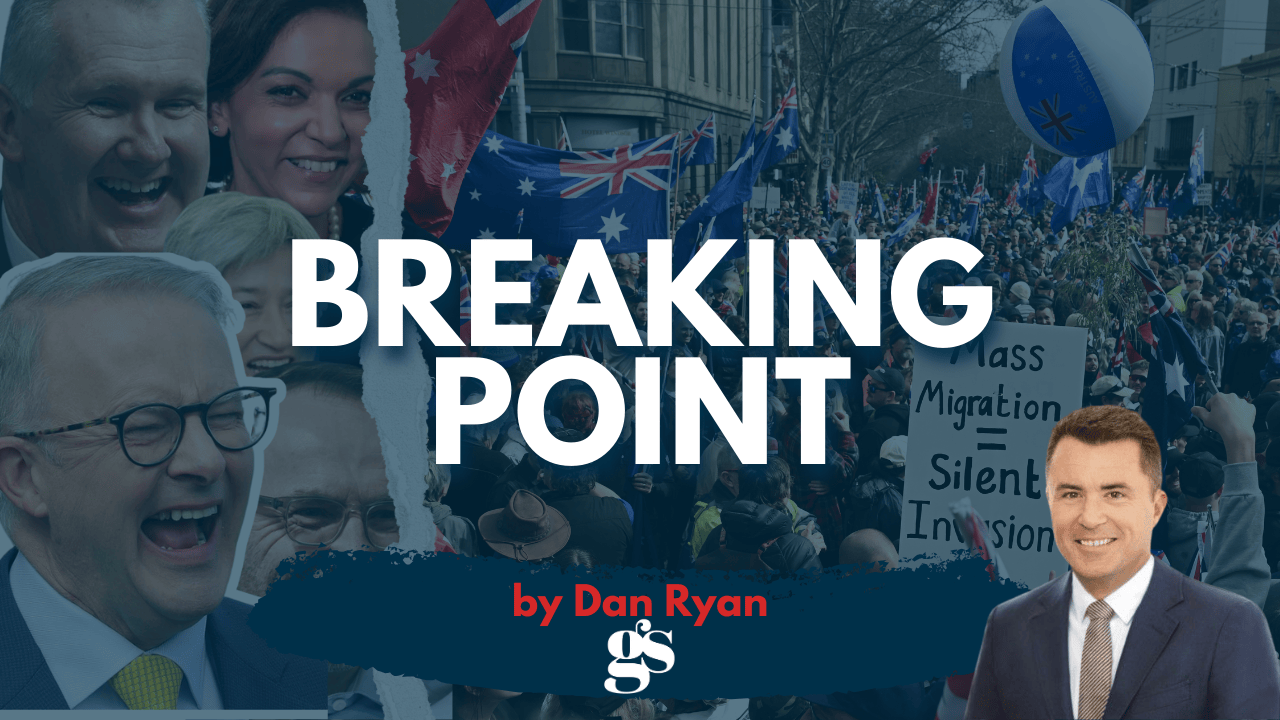
This weekend, the idea that Australia was bucking the trend on debates over immigration was stamped to bits.
My country has mostly avoided the recent populist uprisings in the rest of the Anglosphere and Europe. There’s been no Reform surge, no Trump moment, no AfD equivalent. A high standard of living, strong institutions and a consistently growing economy meant that liberal commentators were able to smugly proclaim that everything seemed basically fine.
But on Sunday, Australians, famously laid back when it came to politics, went on the march. Tens of thousands took to the streets in cities across the country in what was branded the “March for Australia”. It was the largest public display of outwardly patriotic pride the country has seen in decades. Navy blue flags blanketed entire streets as protestors called for an end to mass immigration and the removal of Anthony Albanese, the Labor prime minister.
The reaction from the media and political class was mixed, thanks to the decentralised nature of the event. In Queensland, where the marches were managed by a small coalition of conservative content creators, the centre-Right Liberal Party premier refused to condemn the marches, saying that people have a right to protest. In Victoria, where violent scuffles between counter-protestors and far-Right neo-Nazi elements took place, the Labor premier condemned the protests outright, saying that “there’s no room for hate in Australia”.
Federally, government ministers tried to establish a counter-narrative to the event, quickly condemning the marches. “We don’t support rallies like this that are about spreading hate and that are about dividing our community,” one minister told the media. Conservative North Queensland MP Bob Katter went viral after he threatened to punch a journalist for asking why he was marching if he had distant migrant heritage. “Don’t say that mate… I’m an Australian,” he shouted at him.
Despite the visible presence of fringe and extreme elements in the groups, much of the media conceded that it was not their show. “We just need to have immigration under control; there is not enough housing for our kids. I am petrified for my grand-kids,” one protestor told journalists. Preliminary estimates of the turnout range in the mid-tens of thousands nationwide – an astonishing number for a country that has so far avoided the populist uprisings seen in Britain or Europe.
The marches began on TikTok in response to a video showing an Australian flag being burned at a pro-Palestine rally. After that incident, an anonymous account posted a video calling for a protest to “take back our country”. From there, a website was set up and digital pamphlets were distributed online. These pamphlets quickly spread like wildfire in group chats and newsfeeds across the country.

But the real pressure that led to these marches had been building for years. Since the pandemic, Australia has maintained one of the single largest immigration intakes in the world. On a per-capita basis, it even exceeded Britain’s migrant intake. While Australia has indeed avoided a recession in recent decades, GDP per capita is in decline. Many Australians are watching their once world-leading living standards rapidly decline.
Another major driver for the marches was house prices. Australia’s major cities have some of the most unaffordable housing in the world. Real wages have fallen back to 2008 levels, and the wealth gap between homeowners and renters continues to grow exponentially. Recent data showing that new migrants overwhelmingly voted Labor sparked concerns about democratic disenfranchisement. Other statistics have entered the mainstream debate, including arguments over the nearly 800,000 international students enrolled in Australian institutions. Pro-Palestine marches and an increase in home invasions have fuelled a narrative that Australia’s immigration system is failing.
The government is now in a bind. Anthony Albanese is desperate to avoid being the prime minister who created a recession, and is importing migrants to stop this from happening. However, in doing so he risks sacrificing the country’s living standards, social cohesion and safety.
What is notable is the distinct lack of political representation for those marching. While Katter may have channelled mainstream anger at a media class that for years ignored concerns over immigration, he is by no means the figurehead leading the pushback against immigration. The centre-Right Liberal Party, now in opposition, is seen as equally complicit in the crisis. Some MPs, growing frustrated with their party’s apparent inability to address and capitalise on the issue, are straying from the party line. Talks of leadership challenges and new parties forming abound in chat groups.
Despite Australia’s lack of its own political response to mass immigration, in the form of a Reform UK, or even with tougher-talking legacy party figures like Robert Jenrick, it is clear that the anger that led to Sunday’s marches isn’t going anywhere. Australia, once held up globally as the country to look up to on immigration, is quickly realising it is no different from the rest of them. It may be far away, but it is not far behind.
First published in UK Daily Telegraph 3 September 2025 as “Immigration pressure has been building for years in Australia. This weekend it exploded” © Jordan Knight 2025. All Rights Reserved.
WHAT DO YOU THINK? Add your comments below...
Dan Ryan is a director of The National Conservative Institute of Australia, a think tank focused on putting the nation-state and traditional conservatism back at the heart of policy formation and decision making in Australia. He's a commercial and technology lawyer with over 20 years of high-level advisory and transactional experience. He has worked as general counsel for technology companies based across the globe and has particular expertise in China and tech in the Asian region. He speaks Mandarin and is a former board member of the Australia-China Council. You can follow him on 𝕏 or read more from his blog here.