In writing for The Australian newspaper, journalist Adam Creighton comments that the Ukraine war has joined climate change and Covid-19 as the latest wellspring of government propaganda misinformation. Creighton says:
“It’s no coincidence climate change, Covid-19 and war propaganda all have the same side-effect of increasing government power over the economy and society, and enriching a handful of powerful corporations that hold much sway over their politics, be they in pharmaceuticals, energy, or weapons manufacturing.”[1]
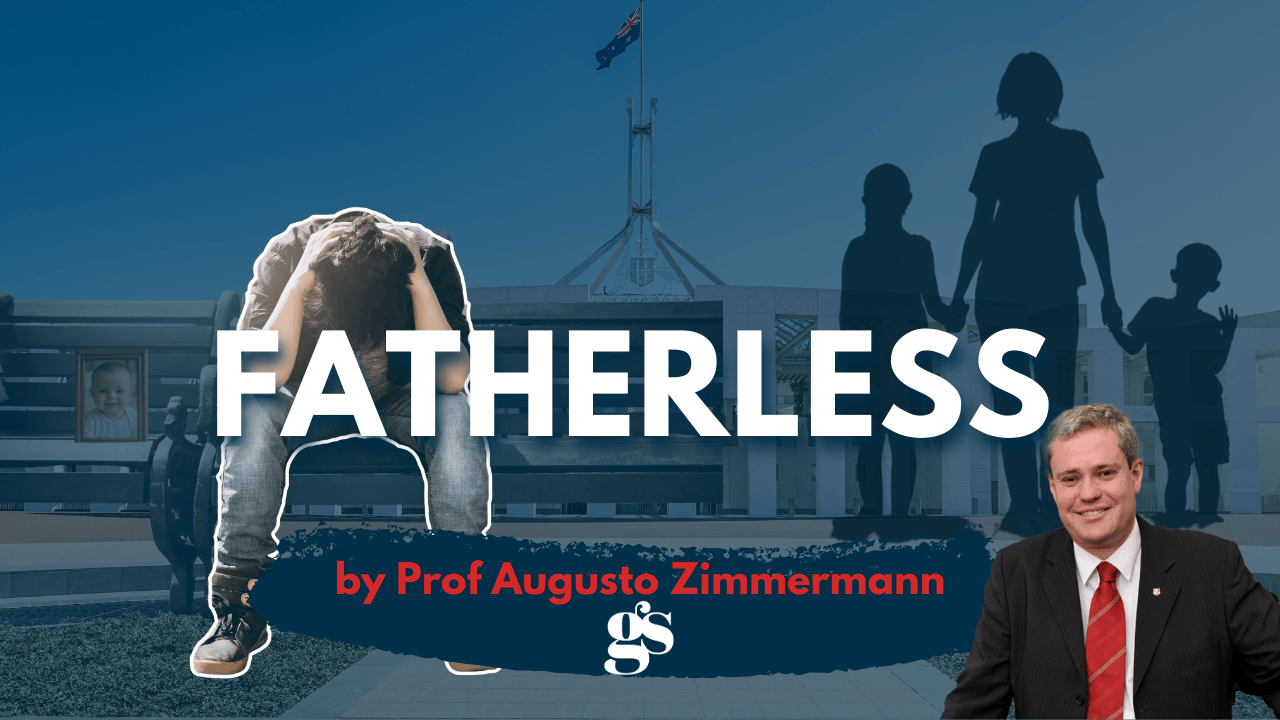
Over 1 million Australian children are living without their fathers. The legislation underpinning both the family court system and the child support scheme have been a major factor contributing to the present crisis of fatherlessness (and male suicide) in this country.
It is worth noting that research studies indicate that divorce following the loss of meaningful contact with children is a major factor of male suicide. The death rate in Australia amongst child-support payers is almost double the rate of males who do not have administrative child support assessments.
Contrary to popular belief, child support payments have nothing to do with irresponsible fathers abandoning their children. Developed in the late 1980s to outset the jurisdiction of the courts, the nation’s child support scheme was largely driven by the need to ensure that private transfers of money from fathers to mothers reduced the burden of the state in terms of welfare expenditure.
Many women today can contemplate divorce with greater confidence that the financial benefits might outweigh the losses. For men, by contrast, a particular cause of dismay has been the imminent loss of contact with children they have loved, protected, and helped raise.
A common scenario is where the wife leaves, taking the children with her – and sometimes all the furniture too. These deserting wives get custody of the children, most of the value of the family house, and the child support agency ensures that the victimized husbands pay support for children they rarely see.
Another familiar scenario is where the husband is required to pay the mortgage charges but also forced to leave the family home immediately and pay rent for a separate residence for himself. As noted by Dr Barry Maley, a family policy expert:
His marriage and its expectations have been destroyed, he has largely lost his children, lost his home and a large part of his income. His prospects of mending his shattered and impoverished life, re-partnering, and perhaps having other children, are minimal.
One can hear the testimony of countless husbands whose wives have run off and been awarded sole custody of children, while they are expected to pay child support and sometimes even spouse maintenance.
There is a clear link between the child support scheme and attempts to eradicate the relationship between children and fathers. These fathers are paying support through the government yet remain alienated from their children.
Given that child support is calculated on the number of nights children spend with fathers, a moral hazard is created that can tempt a primary carer to withhold access for the basest of reasons, money.
Rob Tiller, a Perth-based counsellor, thus reminds us of the male suicide epidemic currently taking place in Australia, where young, middle-aged, and senior men are killing themselves at a rate of 42 per week. This increase in male suicide, he says, is at least partially due to relationship breakdown and parental alienation, coupled with poorer support among divorced males.
According to research by the Australian Institute of Suicide Research and Prevention, almost half of all the suicides by Australian men are directly linked to family court disputes, including child custody and other pending legal matters.
It is undeniable that divorce followed by the loss of assess to children has a strong net effect on mortality from suicide, but only among men. Amongst women, there is no statistically significant differentials in the risk of suicide by marital status categories.
My Personal Experience as a Law Reform Commissioner
I served the Law Reform Commission of Western Australia from 2012 to 2017. In December 2013, our Commission published a Discussion Paper entitled ‘Enhancing Laws Concerning Family and Domestic Violence – Discussion Paper’. The Paper was followed by a comprehensive consultation with individuals expressing their concerns about family and domestic violence.
Published in June 2014 and entitled ‘Enhancing Family and Domestic Violence Laws’, our Final Report addressed all the effects of legislation dealing with family violence.
Unfortunately, however, our recommendations were considerably ignored under the Restraining Orders and Related Legislation Amendment (Family Violence) Bill 2016 (WA), which received Royal Assent on 29 November 2016.
On the occasion, the then WA Attorney-General (Michael Minchin) contended that a new Family Violence Restraining Order (FVRO) was designed to reduce the onus on the accuser to provide evidence of violent behaviour.
Further, the then WA Police Minister, Lisa Harvey, had the audacity to declare:
We’re sending a message to the courts that we would prefer them to err on the side of the victim [that is, the accuser] and err on the side of granting one of the violence restraining orders in these scenarios because they do protect women.
This basically removes the presumption of innocence It assumes that it is acceptable to err on the side of the accused. Such removal of evidence erodes the right to remain innocent until proven guilty.
In our Final Report, the Commission rejected these moves, noting they were likely to exacerbate the existing problem of overuse and abuse of restraining orders, which are known to be used for tactical purposes in the context of family law litigation.
Approached on the occasion by two journalists of The Australian newspaper, I stated:
What this does is erode the very idea of natural justice and the right to remain innocent until proven guilty. This has serious consequences in relation to how respondents can be forced out of their homes, lose access to their children and other rights, without the required for evidence to be provided.

The extension of the removal of evidence even to the grant of final DVOs is totally against what the Commission recommended. The fact that the government claimed these changes were a result of a recommendation of the Commission is patently false.
Of course, it is extremely important to protect women who are at risk. But this should not be done in disregard for legal protections to ensure fair treatment for the accused.
In our Final Report, we explicitly informed that:
It is vital to acknowledge that not every person who applies for a violence restraining order is a victim of family and domestic violence and not every respondent is a perpetrator …
Although it is true that most applications for violence restraining orders are properly made, sometimes they are unmeritorious or otherwise used for tactical purposes in family law litigation. And yet, many lawyers consider that violence restraining orders, in particular those applied for after proceedings have been instituted in a family law dispute, may actually exacerbate conflict and decrease the prospects of the parties reaching agreement, with a consequent impact upon legal costs.
Because an interim violence restraining order can be made on the uncorroborated evidence of the applicant, the potential for abuse is very real. One example repeatedly mentioned to the Commission during its consultations is where the person protected by a violence restraining order is the perpetrator and the person bound is the victim. Further, it is important to acknowledge, from the respondent’s perspective, the potential consequences of a violence restraining order: exclusion from the family home; prohibition of contact with children; inability to work; and general restrictions on day-to-day activities. Additionally, a respondent is liable to serious consequences under the criminal law for failure to comply with the order (including an interim order).
For these reasons, the justice system must ensure that the legal rights of all parties are respected and, in particular, that respondents to violence restraining order applications have a right to be heard within a reasonable time. Additionally, the importance of ensuring that the legal system responds to family and domestic violence in a fair and just manner supports the provision of better and more reliable information to decision-makers at the outset, thus enabling more accurate and effective decisions to be made.
Our Commission’s Final Report was patently clear: ‘the justice system must ensure that the legal rights of all parties are respected and, in particular, that respondents to violence restraining order applications have a right to be heard within a reasonable time.’
However, DVOs at least in Western Australia are usually granted with no evidence. The then Attorney-General stated: ‘We will be moving away from the need for establishing evidence of an act of abuse, as is currently the case’ [emphasis mine].
Following the same line of reasoning the then Police Minister declared:
To be able to intervene at that point, before that control, coercion and intimidation escalates to violence is a step in the right direction and a huge step for these women who are trapped in those relationship.
The word before is important. Here the minister is supporting the idea that the full apparatuses of the State should be activated even when no violent action actually takes place.
It is a frightening reality that a perfectly innocent person stands to lose his home, children and reputation, because of perceived apprehensions. This is happening on a daily basis as a consequence of laws which fail to require the normal standards of proof and presumption of innocence.
To make it worse, the WA Police have a pro-arrest policy for allegations of domestic violence. ‘Arrest is the preferred option’, informs us the relevant police manual (COPS Manual, DV 1.1.4.1), even in situations where there is actually no evidence that violence has ever taken place.
The former Chief Justice of Western Australia, Wayne Martin, told the Law Reform Commission that such a presumption of arrest ‘inevitably produces injustice and hardship in some cases’.
The result, of course, comes with a heavy price: the destruction of countless innocent lives.
One of the most disturbing trends in contemporary society is the increasing distance, if not complete alienation, of fathers from their biological children. For divorced or separated men, a particular cause of dismay and distress may be the loss of contact with children they have loved, protected, and helped raise.
In Australia, thousands of fathers have had their contact with their children limited to a few hours and often spend huge sums on lawyers, fighting to be able to care for their children overnight. One can hear the testimony of good fathers whose spouses have run off and been awarded the sole custody of their biological children while they are expected to pay full support.
The more a mother can restrict the father’s access to the children, the more financial reward she receives in the form of compulsory support payments extracted from the father. Add false accusations of domestic violence, and then the father will be required to prove his innocence before he is allowed within 100 metres of his children.
Indeed, a restraining order, even when based on allegations that are unsubstantiated, is a powerful weapon in the fight for primary custody and restricted access. David Collier, a retiring judge from the Parramatta Family Court, explains that false accusations of domestic violence have become a “major weapon” in the war between parents who wish to secure full custody of their children.
Bettina Arndt has also noted that there is a problem.
Surveys of magistrates have revealed most agree that false allegations of violence are being used to gain an advantage in family law battles. That’s why most family law cases now include allegations of violence. Such an allegation often results in good fathers having to pay for supervised contact to see their children, and most end up losing contact. The current system is set up to disadvantage fathers, and the proposed changes will make it so much worse.
The evidence is overwhelming that when marriages fail, Australian fathers are much less likely to be awarded custody of their children and far more likely to be displaced from the family home. Since the system tends to favour women with the custody of children and the family home (even where men are unemployed and have nowhere else to go), these are significant factors in the growth of male homelessness and suicide in Australia.
Naturally, sensible people would see this as a pointer to the protective nature of the bond between daughters and fathers. Nonetheless, avoiding parental alienation and defending the important role played by fathers in the protection of their children is not part of the prevailing agenda.
WHAT DO YOU THINK? Add your comments below...
Dr Augusto Zimmermann PhD, LLM, LLB, DipEd, CertIntArb is a well-known expert in Brazilian law, and the author of numerous books and articles on Brazilian Constitutional Law, including Direito Constitucional Brasileiro – Tomes I & II (Rio de Janeiro/RJ: Lumen Juris, 2014), and Curso de Direito Constitucional (4th ed., Rio de Janeiro: Lumen Juris, 2006). He is also co-author of the book Deconstructing Scomo. He is Professor and Head of Law at Sheridan Institute of Higher Education in Perth, WA, and Professor of Law (Adjunct) at the University of Notre Dame Australia, Sydney campus. He is President of the Western Australian Legal Theory Association (WALTA), and former Law Reform Commissioner with the Law Reform Commission of Western Australia, from 2012-2017. Dr Zimmermann was chair and professor of Constitutional Law at Murdoch University from 2007 to 2017.